
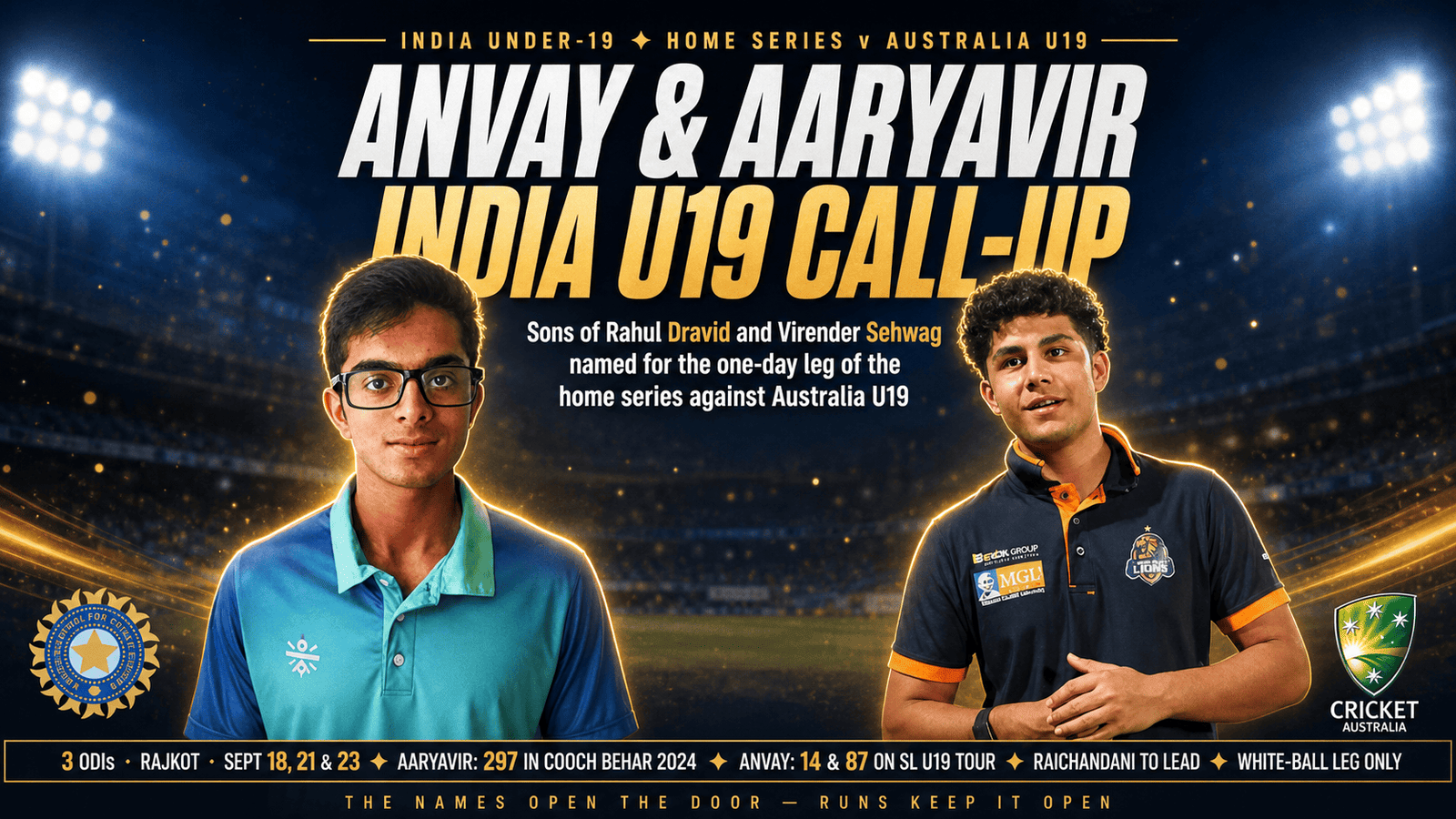
Some surnames arrive with their own noise. Before a young player has taken guard, people have already remembered old cover drives, old square cuts, old Test mornings and old television highlights. That is the delicate place Anvay Dravid and Aaryavir Sehwag now step into, not as memories, but as cricketers trying to begin their own international youth journey.
The sons of Rahul Dravid and Virender Sehwag have been named in India’s Under-19 one-day squad for the home series against Australia U19. The BCCI selection committee announced the squad on Thursday, with the tour featuring three one-day matches and two multi-day fixtures. Anvay and Aaryavir have been picked for the one-day leg, while they are not part of the multi-day squad.
The famous names
It is impossible to pretend the family connection is not the first talking point. Rahul Dravid and Virender Sehwag shaped an entire era of Indian batting in completely different ways. Dravid built innings like a patient architect. Sehwag attacked bowling attacks with a freedom that still feels modern. Their sons being picked in the same youth squad naturally invites curiosity.
But that curiosity can be both a gift and a burden. A young player with a famous surname gets attention quickly, but also faces judgment quickly. Every failure looks louder. Every success is compared with something that happened long before he was old enough to understand it.
That is why this selection should be treated with perspective. This is not a handover from one generation to another. It is a first visible step for two boys in a system where performances must keep opening the next door.
The one-day call
Aaryavir Sehwag has been selected as a right-handed batter. He has been playing for West Delhi Lions in the Delhi Premier League, and he had already caught attention in age-group cricket with a huge Cooch Behar Trophy score of 297 against Meghalaya in 2024. That kind of innings does not guarantee anything, but it does show appetite. In youth cricket, appetite matters.
Anvay Dravid, Rahul Dravid’s younger son, comes in as a wicketkeeper-batter. He was also part of India’s Under-19 squad for the Sri Lanka tour in July. News18 reported that he made 14 and 87 in two youth ODIs on that tour, which gave selectors a recent look at him in the national junior environment.
The interesting part is that both are in the white-ball group only. The multi-day squad has a different balance, which is a reminder that the Under-19 pathway is not only about names. Selectors are trying to split roles, workloads and formats.
The squad shape
Lakshya Raichandani will captain India in the one-day matches, with Yashbardhan Chauhan named vice-captain. In the multi-day fixtures, the roles are reversed: Chauhan leads and Raichandani becomes deputy. That gives both players leadership exposure across formats, a detail that matters at this level.
The one-day squad includes Rajat Baghel and Anvay as wicketkeeper options. It also features Aaryavir, V.K. Vineet, Kushagra Ojha, Arjun Rajput, Manal Chauhan, V. Yashveer, Rohit Yadav, Shavin Vinodh, Mohit Ulva, Chigurupati Venkata and Kavya Patel. For many of these players, the Australia series will be a bigger test than domestic age-group cricket because the pace, fielding standards and pressure usually rise when an international opposition arrives.
The multi-day squad has its own focus. Sagar Virk, Kush Patel, Manav Krishna, Abhipray Biswas, Ishan Om, Ayaan Akram, Pranav Ragavendra, Priyanshu Singh and Aryan Yadav join several names from the white-ball pool.
The Indian angle
For Indian cricket followers, Under-19 squads always carry extra fascination. The country has seen enough youth cricketers become senior stars to know that these lists can matter. At the same time, it has also seen enough teenage promise fade to know that patience is necessary.
The Dravid-Sehwag headline will pull clicks, but the deeper story is India’s junior pipeline. The selectors are trying to identify batters, keepers, bowlers and leaders who can handle a faster cricket education. Australia at Under-19 level is a useful opponent because the contests usually demand both skill and nerve.
For Anvay, the challenge will be to keep improving as a wicketkeeper-batter without becoming only a surname story. For Aaryavir, the challenge will be to convert reputation and strokeplay into consistent runs. Both will know that Indian cricket is crowded. There is always another batter waiting.
The venues
The three one-day matches are scheduled in Rajkot on September 18, 21 and 23. The first multi-day fixture will also be played in Rajkot from September 27 to 30. The second multi-day game is listed for Ahmedabad B Ground from October 5 to 8.
That schedule gives the one-day group a compact test. There is little time to recover from a bad game and little time to celebrate a good one. For young players, that is useful. It teaches the rhythm of tournament life: review quickly, train properly, move again.
What comes next
The selection is only the beginning. There will be photographs, social media attention and family comparisons, but the real work will come quietly in the nets and then loudly in the middle. Australia U19 will not bowl to a surname. They will bowl to a batter.
That is the point Anvay Dravid and Aaryavir Sehwag must eventually make for themselves. The names open the conversation. Runs, catches, discipline and repeat performances keep it alive.
For Indian fans, the nostalgia is natural. Two famous cricket families have returned to a national team sheet. But the better way to watch this series is not through the past. It is to see whether two young players can begin building something that belongs to them.