
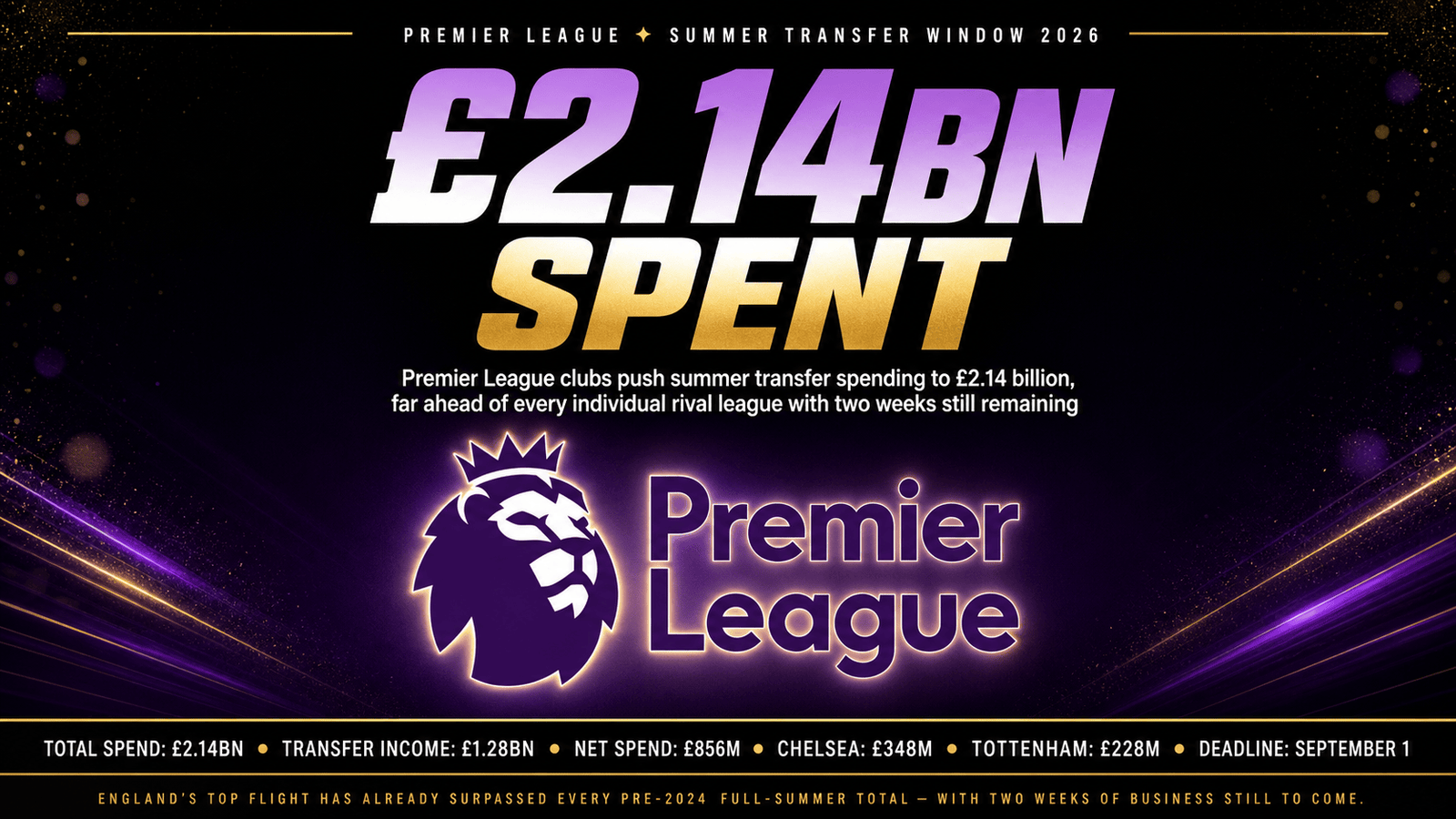
The numbers, when you see them laid out, have a way of making you blink. Premier League clubs have already spent £2.14 billion on transfer fees this summer, with two weeks of the window still to run. That is more than the entire outlay for any full summer before 2024, and it has been achieved with the deadline still distant on the horizon.
The Premier League’s money machine, it seems, has no off switch. And the rest of European football can only watch.
The context makes the figure almost absurd. Serie A clubs have spent £780 million in the same period. La Liga, £515 million. The Bundesliga, £505 million. Ligue 1, £412 million. Add all four together, and they still fall short of what England’s top flight has splurged on its own.
It is a dominance that goes beyond mere spending power. It is a structural advantage, a financial ecosystem so far ahead of its rivals that the comparison has almost ceased to be meaningful.
The big spenders
At the top of the pile, the usual suspects. Chelsea lead the way, having committed £348 million so far this summer, a figure that would once have represented an entire league’s expenditure. Tottenham are next on £228 million, with Arsenal and Manchester City both on £151 million.
What is striking about this year’s window is the extent to which the biggest clubs have spent on each other. Chelsea, Tottenham and Manchester City have all broken their club transfer records during the window, and the flow of money between Premier League clubs has become a dominant feature of the market.
Intra-Premier League spending reached £1.29 billion last season, the highest summer figure since 2016. This summer’s in-house outlay represents almost a third of all Premier League transfer expenditure, a sign that the league has become a closed ecosystem, its wealth circulating among its own members.
The net spend story
Gross spending, of course, tells only half the story. Premier League clubs have received £1.28 billion in transfer fees this summer, leaving the division with a net spend of £856 million. It is a reminder that the league does not merely spend; it also sells, and the money that flows in from abroad helps to offset some of the enormous outlay.
But the headline figure, the £2.14 billion, is the one that captures the imagination, and the one that will be quoted when the window finally closes. If spending continues at its current pace, the total could surpass the 2025 record of approximately £3.1 billion to £3.2 billion, a staggering milestone that would have seemed unthinkable a decade ago.
The concerns beneath the surface
For all the spectacle of it, there is an unease beneath the surface of this spending binge, and it is worth acknowledging.
Many of the deals are being done on credit, with Premier League clubs already owing £3 billion in transfer instalments before this window even opened. The financial sustainability of the league’s spending is, increasingly, a subject of serious debate.
There is also the question of player power, and the behaviour of certain professionals who have agitated for moves by effectively going on strike. The summer has seen a number of players down tools to force transfers, and the sight of millionaires refusing to play until they are sold does not sit easily with many fans.
And then there is the simple, uncomfortable truth that the concentration of wealth at the top of the game is intensifying. The Premier League’s financial dominance is good for the Premier League, but it is not necessarily good for football, and the widening gap between England and the rest of Europe is a cause for genuine concern.
The Indian angle
For Indian football fans, the Premier League’s spending spree is a source of both fascination and a certain wistfulness. The league is watched with enormous passion across the subcontinent, its stars household names, its title race followed with an intensity that rivals any domestic competition.
But there is also a recognition that the financial model that powers the Premier League is not one that Indian football can simply replicate. The Indian Super League, for all its growth, operates on a scale that is a rounding error compared to the Premier League’s billions. The gap is vast, and it is not closing.
And yet, the Premier League’s success is, in its own way, an advertisement for what football can become when it is properly marketed and managed. The money that flows through the English game is a product of decades of commercial development, and it is a reminder of what is possible when a league gets its foundations right.
What the rest of the window holds
With two weeks of the window still to run, the spending is far from finished. The transfer deadline on September 1 is likely to bring the usual flurry of late deals, and the final figure, when the window slams shut, could well set a new record.
The clubs will keep spending, the agents will keep earning, and the money will keep flowing. It is the way of the modern game, and the Premier League, more than any other competition, has mastered the art of it.
For the fans, the spending spree is a source of endless speculation and excitement, a reminder that in the Premier League, the season never really ends. There is always another signing, another saga, another record to be broken.
The £2.14 billion already spent is just the beginning. By the time the window closes, the Premier League will have made its point, once again, more emphatically than ever.