
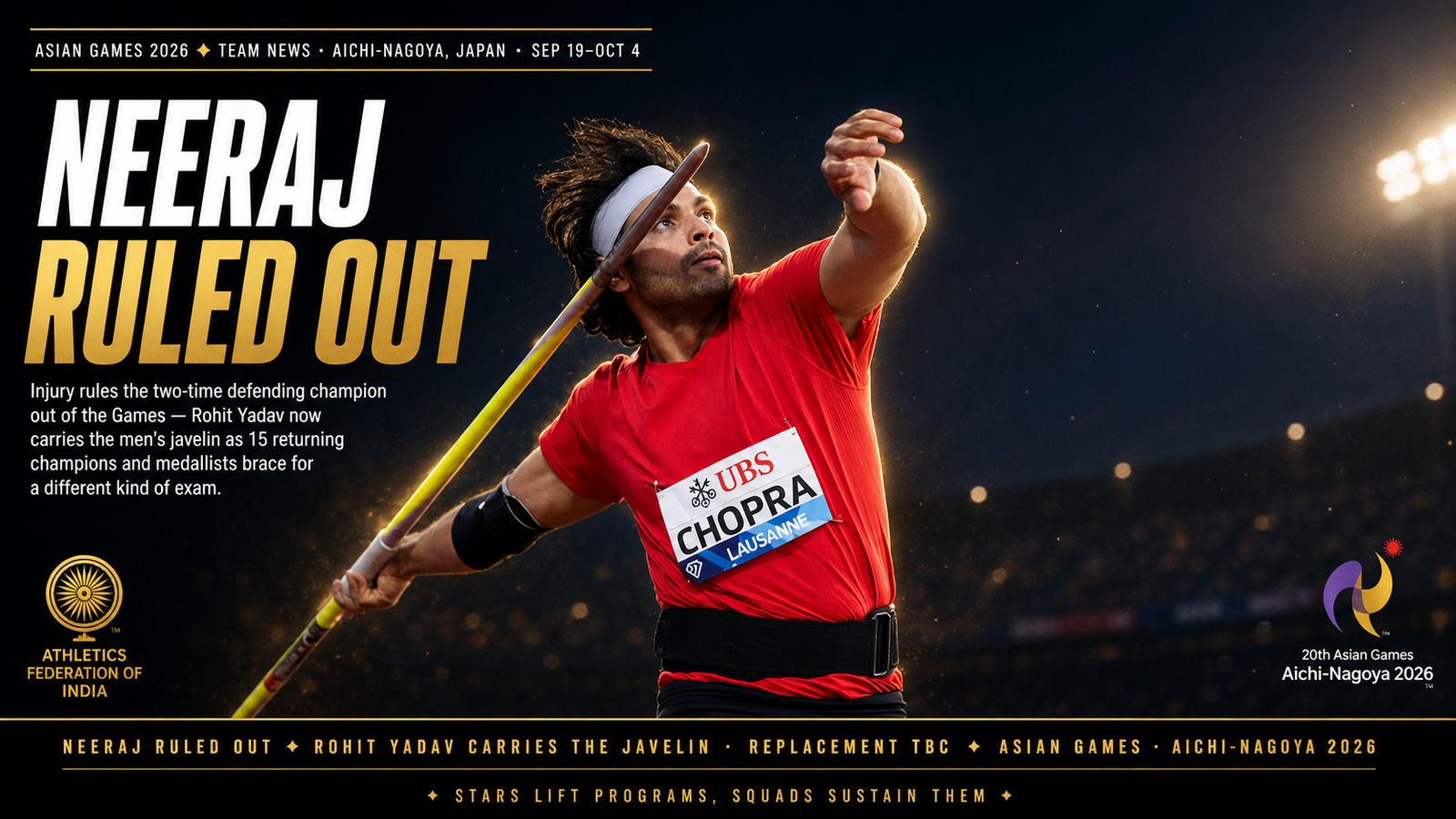
Some absences change a squad list. Others change the mood of an entire campaign. Neeraj Chopra being ruled out of the Asian Games 2026 does the second. India will still travel to Aichi-Nagoya with a strong athletics team, but it will do so without the man who has so often turned javelin nights into national viewing events.
Olympics.com reported that Neeraj, a two-time Olympic medallist and the defending Asian Games javelin champion from both Jakarta 2018 and Hangzhou 2023, has been ruled out through injury. He had initially been named in India’s 73-member athletics squad for the Games, scheduled from September 19 to October 4 in Japan, but will no longer defend his titles. Rohit Yadav remains selected in the men’s javelin throw, while Neeraj’s replacement is expected to be named shortly.
For Indian sport, this is a headline with two layers. The first is emotional, because Neeraj is no ordinary name. The second is competitive, because India’s best Asian Games athletics campaign in decades now has to be followed without its brightest track and field star.
The javelin gap
India has grown used to seeing Neeraj as the safest headline in a major athletics squad. That does not mean every final has been easy, but it does mean he has carried a different kind of expectation. When Neeraj enters a competition, the conversation begins with medals rather than hopes. That is rare in Indian athletics.
His absence opens a difficult space. The men’s javelin event still has Rohit Yadav, and he now becomes central to India’s plans. But replacing Neeraj is not as simple as moving one name into another slot. Neeraj brings history, big-final calm, brand pull and tactical intelligence. He also brings fear for opponents because they know one throw can change a medal table.
The timing makes the loss sharper. Aichi-Nagoya is close, and the final preparation block matters. A late injury withdrawal leaves coaches, selectors and fans waiting on a replacement while also adjusting the medal conversation.
India should not turn the javelin event into a story of damage control only. That would be unfair to Rohit and whoever joins him. But it is realistic to say the pressure picture has changed.
The squad still has depth
The important part of the announcement is that India’s athletics squad is still packed with experience. Olympics.com reported that the team includes 15 returning Asian Games champions and medallists. That is not a consolation line. It is the reason India can absorb a major blow and still travel with ambition.
Avinash Sable, Tajinderpal Singh Toor, Parul Chaudhary and Annu Rani are the four individual champions from Hangzhou 2023 who remain in the squad. Rajesh Ramesh, part of the men’s 4x400m relay gold-winning team in Hangzhou, is also selected.
Sable returns in the 3000m steeplechase after an injury-hit spell that included surgery on his right knee. Tajinderpal will chase a hat-trick of Asian Games shot put titles. Parul has been picked across the 1500m, 5000m and 3000m steeplechase, which shows both trust in her engine and the workload she may carry. Annu Rani returns as the defending women’s javelin champion.
There are also familiar medal hopes in Jyothi Yarraji, Murali Sreeshankar, Tejaswin Shankar, Gulveer Singh, Mohammed Afsal, Ancy Sojan, Praveen Chithravel and Vithya Ramraj. The squad is not built around one event. That becomes even more important now.
India’s medal memory
The reason Neeraj’s absence hurts so much is also the reason the rest of the squad should feel belief. Hangzhou 2023 changed the way India talks about athletics at the Asian Games. India won 29 medals in track and field there, with six gold, 14 silver and nine bronze. It was the country’s best Asian Games athletics haul since the inaugural edition in 1951.
Athletics was also India’s most successful sport in Hangzhou by total medals. That matters because it shifted public attention. For years, many Indian fans watched athletics only when one superstar was involved. Hangzhou widened the lens. Steeplechase, relays, jumps, throws and distance events all found more space in the national conversation.
Aichi-Nagoya is now the test of whether that surge was a one-edition peak or the beginning of a larger standard. Without Neeraj, the answer will have to come from the group.
That may not be a bad thing in the long run. Indian athletics has to grow beyond even its greatest modern champion. The best systems do not collapse when one star is absent. They bend, reset and find medals through depth.
The Indian angle
For the Indian audience, this story will draw heavy attention because Neeraj sits at the rare crossing point of performance and mass appeal. He is not only followed by athletics fans. He is followed by casual sports viewers, Olympic watchers and people who may otherwise skip a field event until the national anthem is possible.
That gives this news a traffic pull, but it also requires careful framing. The headline is not that India’s Asian Games athletics campaign is over. It is that the campaign has become more complicated and more revealing.
The public reaction will naturally focus on the javelin. But the fuller story is about the team India has built. Tajinderpal’s shot put chase, Parul’s heavy event load, Sable’s return after injury, Jyothi’s comeback to major competition and Annu Rani’s title defence all deserve attention.
If Indian sport wants to become genuinely multi-sport in audience habits, this is the kind of moment that can help. Fans arrive because of Neeraj. They may stay if the wider squad gives them stories to follow.
Who carries the spotlight now
Tajinderpal Singh Toor is one of the obvious names. A third straight Asian Games shot put title would be a major achievement, and his event gives India a clear medal lane. Parul Chaudhary is another central figure because she is listed for three demanding events. Her schedule will test endurance, recovery and tactical planning.
Avinash Sable’s situation is different. The quality is proven, but the body has had to be managed after surgery. If he arrives close to his best, India have a serious contender in the steeplechase. If not, the team will need points and medals from elsewhere.
Annu Rani’s women’s javelin defence now becomes more visible too. With Neeraj out of the men’s event, India’s javelin attention may shift toward her attempt to repeat Hangzhou success.
Then there are the relay teams. Indian relays have often given fans some of the most emotional athletics moments because they feel collective and urgent. In a campaign without Neeraj, a relay medal can carry extra symbolic weight.
The other important group is the athletes who may not begin as front-page favourites but can turn a campaign with one personal-best performance. Asian Games medals often come from those margins. A clean qualification, one strong final attempt, or one brave last lap can shift the colour of a country’s table. India will need that wider hunger now.
What comes next
The immediate wait is for Neeraj’s replacement. That call matters, but the larger job is already clear. India must protect the athletes returning from injury, sharpen event-specific plans and avoid letting one withdrawal dominate the camp’s emotional rhythm.
Neeraj’s absence will be spoken about every day until the athletics events begin. That is unavoidable. The coaching staff’s challenge is to acknowledge the loss without letting it define the squad. The athletes have enough history of their own to chase.
Aichi-Nagoya now becomes a different kind of exam for Indian athletics. With Neeraj, the question would have been whether he could defend again and inspire another big haul. Without him, the question is whether India’s depth can stand in the spotlight.
That may be the more meaningful test. Stars lift programs, but squads sustain them. India will miss Neeraj badly. Now the rest of the team has to show how far the program has really come.