
Some defeats feel bigger than a scoreline. Novak Djokovic has lost matches before, even painful ones, but his US Open first-round exit to Mariano Navone carried the strange silence of an era being forced to pause. It was not only that Djokovic was beaten. It was the way the match slowly turned from routine expectation into a long, uncomfortable watch.
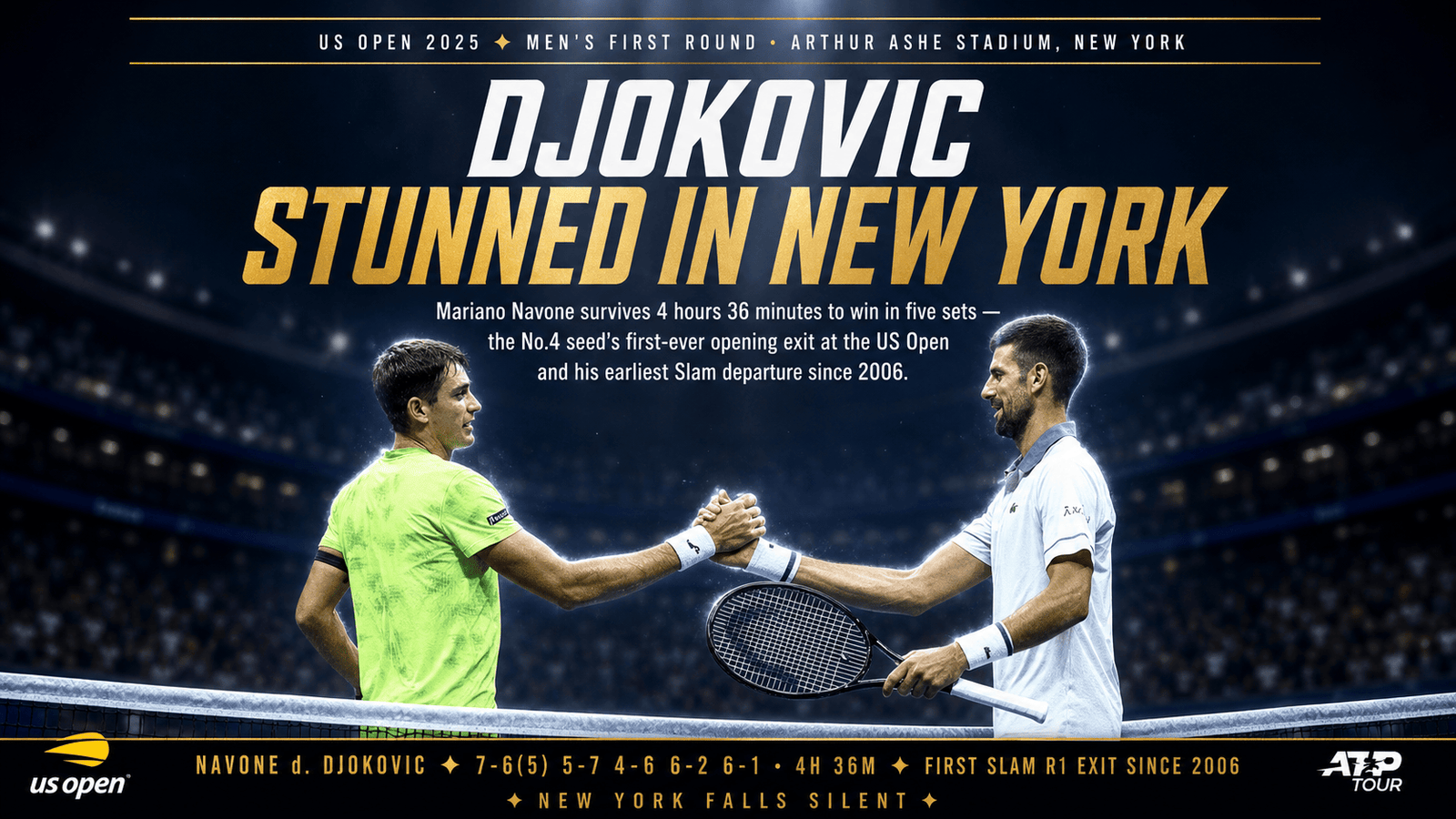
Djokovic, seeded fourth and chasing a record-extending 25th Grand Slam title, went out at Arthur Ashe Stadium after a 7-6(5), 5-7, 4-6, 6-2, 6-1 defeat to Argentina’s Navone. The match lasted 4 hours and 36 minutes, making it the longest opening match of a Grand Slam in Djokovic’s career. It was also his first ever first-round loss at the US Open and his earliest Grand Slam exit since the 2006 Australian Open.
For Indian tennis followers who have grown up watching Djokovic turn danger into routine escape, this was a jolt. The familiar recovery was there for a while. The familiar stubbornness was there too. But the body did not follow the mind all the way to the finish.
The result that shook New York
The first set gave the night its warning. Djokovic led early, but Navone refused to let the match settle into the pattern that so many Djokovic opponents have accepted over the years. The Argentine kept asking for one more ball, one more rally and one more uncomfortable step. When the opener went to a tiebreak, Djokovic’s rhythm looked thinner than usual. Navone took it 7-6(5), and suddenly the stadium had the feeling of a live upset rather than a slow warm-up for a champion.
Djokovic responded like Djokovic. He pulled the second set back 7-5 and then moved ahead by taking the third 6-4. At that point, many watching from India would have expected the story to close in familiar fashion. Djokovic had survived the worst part, adjusted to the opponent and found the scoreboard lead.
Instead, the match went the other way. Navone took the fourth set 6-2, then ran through the decider 6-1 as Djokovic’s movement, serve and resistance all faded. The final set was hard to watch because it did not feel like Djokovic being out-thought. It felt like Djokovic being emptied.
Djokovic’s body becomes the story
The physical signs were impossible to ignore. Reports from ESPN and other outlets said Djokovic vomited during the contest, showed signs of cramping, took pills from a doctor and had treatment on his lower back between the fourth and fifth sets. He later spoke about vomiting, pain, cramps, back trouble and shoulder issues, describing the feeling on court as awful.
That matters because Djokovic has built part of his greatness on recovery. He has won matches from positions where the sport had already begun writing him off. He has played through heat, hostile crowds and brutal rallies. He has made five-set tennis feel like a test designed for him.
This time, the problems looked deeper. ESPN reported that he made 70 unforced errors. That number tells a tennis story, but the eye test told a human one. The legs were not always under him. The serve did not have its usual protection late on. The rallies that usually sharpen his focus seemed to wear him down.
Djokovic is 39, and age in tennis rarely arrives as one clean headline. It appears in small delays, in recovery days that do not heal enough, in first matches that feel heavier than they once did. He remains one of the greatest competitors the sport has seen, but this defeat placed his physical condition at the centre of the conversation.
Navone earns his moment
It would be unfair to make the entire night about Djokovic’s suffering. Navone had to earn the biggest win of his career, and he did. The 25-year-old Argentine did not play like someone simply waiting for a legend to collapse. He stayed close when Djokovic threatened to pull away, accepted the long exchanges and used the final two sets with clarity.
Upsets against great champions are often remembered for what the favourite lost. Navone will remember what he won. He held his nerve on one of tennis’ most intimidating courts, against a player he grew up admiring, with the match moving past four hours and the noise around him growing larger by the game.
There was also a tactical edge to his patience. Navone did not need to hit perfect winners every few points. He needed to keep enough depth, make Djokovic move and trust that the match would become more physical the longer it lasted. Once Djokovic’s body began to betray him, Navone still had to stay calm enough not to rush the finish.
That is not easy. Beating a legend is one thing. Beating a wounded legend can be just as difficult because the mind starts seeing the finish line before the match is done. Navone avoided that trap.
What this means for the US Open
A Djokovic exit in round one instantly changes the tournament mood. It removes a four-time US Open champion, a 24-time major winner and one of the few players who could make any draw feel narrower just by being in it. It also changes the emotional shape of the event. For the first time since the 2003 French Open, a Grand Slam second round will not feature Djokovic, Roger Federer or Rafael Nadal.
That statistic is heavy because it speaks to the long goodbye of the Big Three era. Federer is retired. Nadal is no longer a week-to-week presence at majors. Djokovic has continued to hold the final line longer than most expected, but nights like this make the sport feel different.
The younger contenders will feel it too. Carlos Alcaraz and Jannik Sinner have already taken ownership of much of the conversation around men’s tennis, and Djokovic’s early exit leaves more space around that rivalry. It also gives the rest of the draw belief. When a player of Djokovic’s stature falls on the first weekend, the locker room notices.
That does not mean the title is easier in a simple way. Grand Slams often become messier when one giant disappears early. But the pressure now shifts. The players expected to carry the tournament must do it without Djokovic waiting as the ultimate measuring stick in the later rounds.
The Indian fan angle
India has a large tennis audience that follows majors closely, and Djokovic remains one of the sport’s biggest search names here. His matches often cut across casual and serious fans because his career has been tied to the biggest numbers in tennis. The 24 majors, the long reigns at the top, the rivalry with Federer and Nadal, the constant argument over greatness. All of it gives every Djokovic result a wider echo.
This one will travel even further because it combines shock, concern and history. A first-round US Open loss is not a normal Djokovic headline. A five-set loss with visible illness and cramping is not normal either. For Indian fans waking up to the result, the feeling is likely to be a mix of surprise and unease.
There is also the wider sports lesson. Great athletes do not decline only through poor form. Sometimes the body begins asking questions even when the skill remains. Djokovic still has the shots, the memory and the competitive rage. The harder question is whether he can trust his body through seven rounds of best-of-five tennis.
What comes next
Djokovic’s next few weeks will be watched carefully. ESPN reported that the defeat is set to push him out of the ATP top 10 for the first time since July 2018. It also extends his run without a Grand Slam title to 12 majors, matching the longest drought of his career.
Those numbers do not erase what he has done. Nothing can. But they do frame the decision ahead. Does he reduce the schedule further? Does he search for a medical answer that makes long matches safer? Does he aim everything at one more major push?
For Navone, the challenge is different. The best night of his career has to become fuel rather than a finish line. Grand Slam upsets can drain players emotionally. Now he must recover quickly and play again while the tennis world suddenly knows his name.
For the US Open, the story has changed before the first round is even complete. Djokovic arrived chasing another piece of history. He leaves with questions about health, age and how much longer the impossible standard can be extended.
Navone earned the win. Djokovic fought until his body would not let him fight the same way. And tennis, just for one New York night, felt as if a familiar page had been turned sooner than anyone expected.