
Some cricket comebacks are not measured first by runs or wickets. They are measured by whether a player can stand near the boundary again, carry a kitbag again, and believe that the game has not shut its door forever. For Anaya Bangar, Cricket Australia’s decision is that kind of moment.
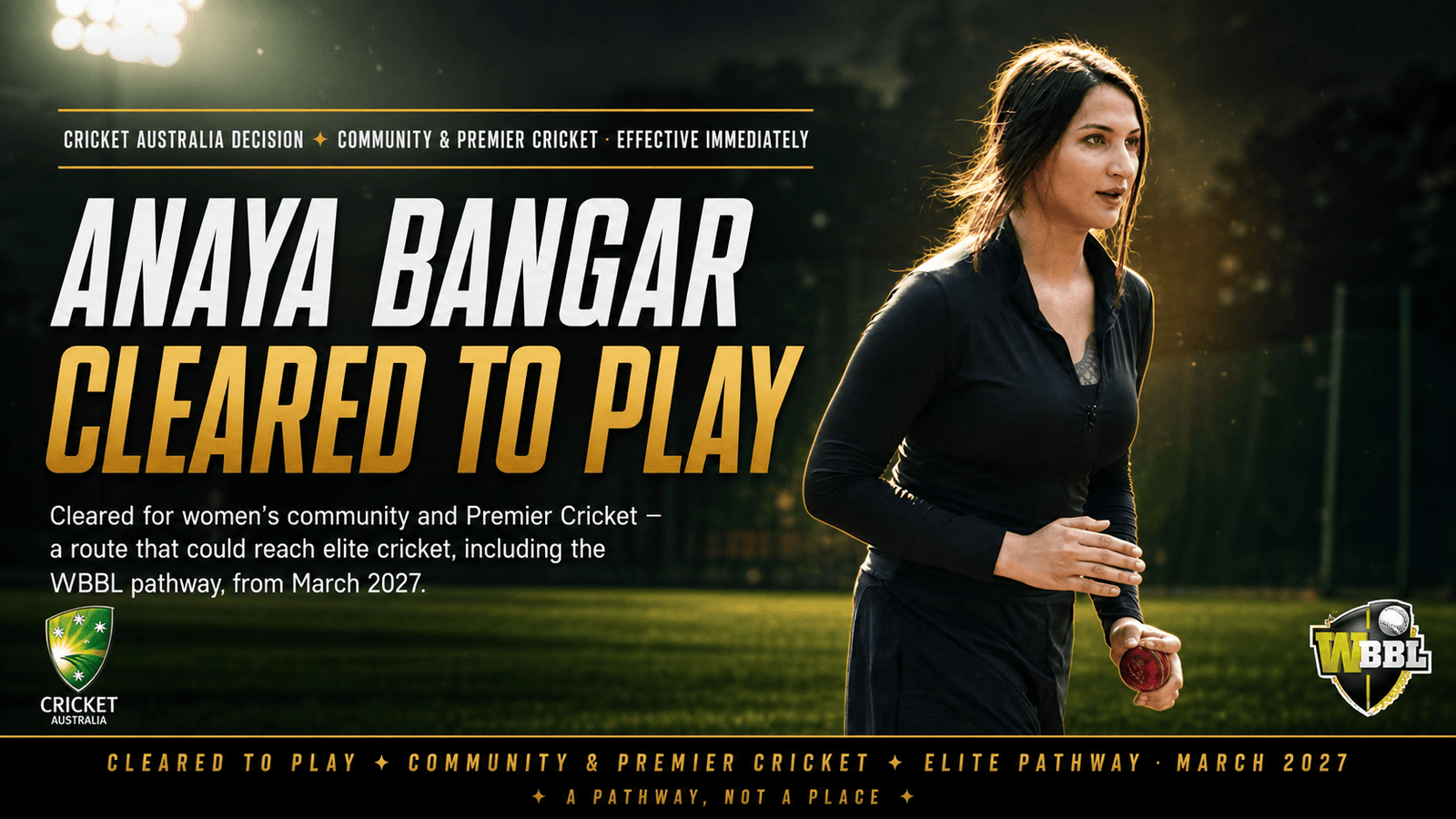
Anaya, daughter of former India cricketer and coach Sanjay Bangar, has been cleared by Cricket Australia to play women’s community and Premier Cricket across Australian states and territories with immediate effect. The decision also creates a possible route toward elite women’s cricket from March 2027, including the Women’s Big Bash League pathway, subject to eligibility rules and performance.
The clearance
The key point is important: this is not automatic selection for an elite team. It is a pathway. India Today reported that Anaya has been cleared for women’s community and Premier Cricket, while her eligibility for elite cricket from March 2027 remains conditional on meeting Cricket Australia’s requirements, including policy criteria and a blood test assessment.
Anaya has been careful in how she describes it. She said Cricket Australia has given her a pathway, not a place in a team. She still has to train, compete, perform and earn an opportunity. That line deserves attention because it pushes the story back where it should be: onto cricket.
In a subject that can become noisy very quickly, her own framing is grounded. She does not want sympathy to select her. She wants the chance to play and then be judged by performance.
The human weight
The emotional part of the story is unavoidable. Anaya said there was a time when she thought she would never play cricket again. For any athlete, that feeling can be devastating. Sport is not only a job or a hobby. It is routine, identity, friendship, discipline and hope. When the route back becomes uncertain, the loss is bigger than a scorecard.
Her words after the clearance carried that weight. She called it a huge milestone, not just for herself but for other athletes like her. She also said the process was not automatic or informal, and that Cricket Australia had considered her case through a framework designed to balance fairness, competitive integrity and inclusion in women’s sport.
Those are not easy balances. Sport governing bodies around the world are still debating how to frame eligibility rules in ways that are fair, respectful and workable. Cricket is no exception.
The India question
The Indian angle is especially sensitive because Anaya’s cricket roots are in India. She previously trained and played as a top-order batter and all-rounder in Mumbai’s youth cricket system. Her father, Sanjay Bangar, has been part of Indian cricket as a player, coach and commentator. That background naturally makes Indian fans pay attention.
India Today’s report also noted that the BCCI does not currently have a clearly established public policy specifically governing transgender participation in Indian cricket. That leaves a difficult gap. Players need clarity before they can plan careers. Associations need rules before they can make decisions. Supporters need information before debate turns into assumption.
Australia’s domestic framework has now given Anaya one possible route. Whether Indian cricket develops a more visible policy of its own is a larger question, and one that will matter beyond one player.
The performance road
The hardest part for Anaya begins now. Clearance allows participation, but cricket will demand proof. Community and Premier Cricket in Australia can be competitive, physical and unforgiving. She will need match fitness, rhythm, form and a club environment that helps her settle.
If she wants to chase elite cricket from March 2027, she will also need to keep meeting the relevant eligibility requirements. That means the sporting and administrative tracks will run together. One part will happen in nets, matches and dressing rooms. The other will happen through documents, tests and policy reviews.
That is a lot for any player to manage, especially under public attention. But Anaya’s comments suggest she understands the size of the road ahead. She has not spoken as if the work is done. She has spoken as if the work can begin.
The wider conversation
This story will produce strong opinions. It already has. The responsible way to read it is to separate eligibility from selection. Cricket Australia has not handed Anaya a WBBL contract. It has created a route under its domestic rules. From there, cricketing performance still has to decide what happens.
That distinction matters because fair discussion should not erase either side of the issue. Women’s sport requires competitive integrity. Transgender athletes require dignity and clear rules. Governing bodies have to carry both responsibilities with seriousness.
Anaya’s case is one example of how complicated and personal those decisions can be. Behind policy language is a player who wants to train, play and be judged properly.
What comes next
Anaya is now looking toward women’s cricket in Australia, with community and Premier Cricket as the immediate steps. If she builds form and continues to meet policy conditions, elite cricket from 2027 could become a possibility. But even reaching that conversation will require performances.
For Indian cricket followers, the story is significant because it touches both sport and society. It asks how pathways are built, how rules are explained, and how athletes are treated when their careers sit inside a debate larger than themselves.
For Anaya, the next target is simpler. Find a club. Train again. Play again. Let the bat, ball and scorebook begin speaking too.