
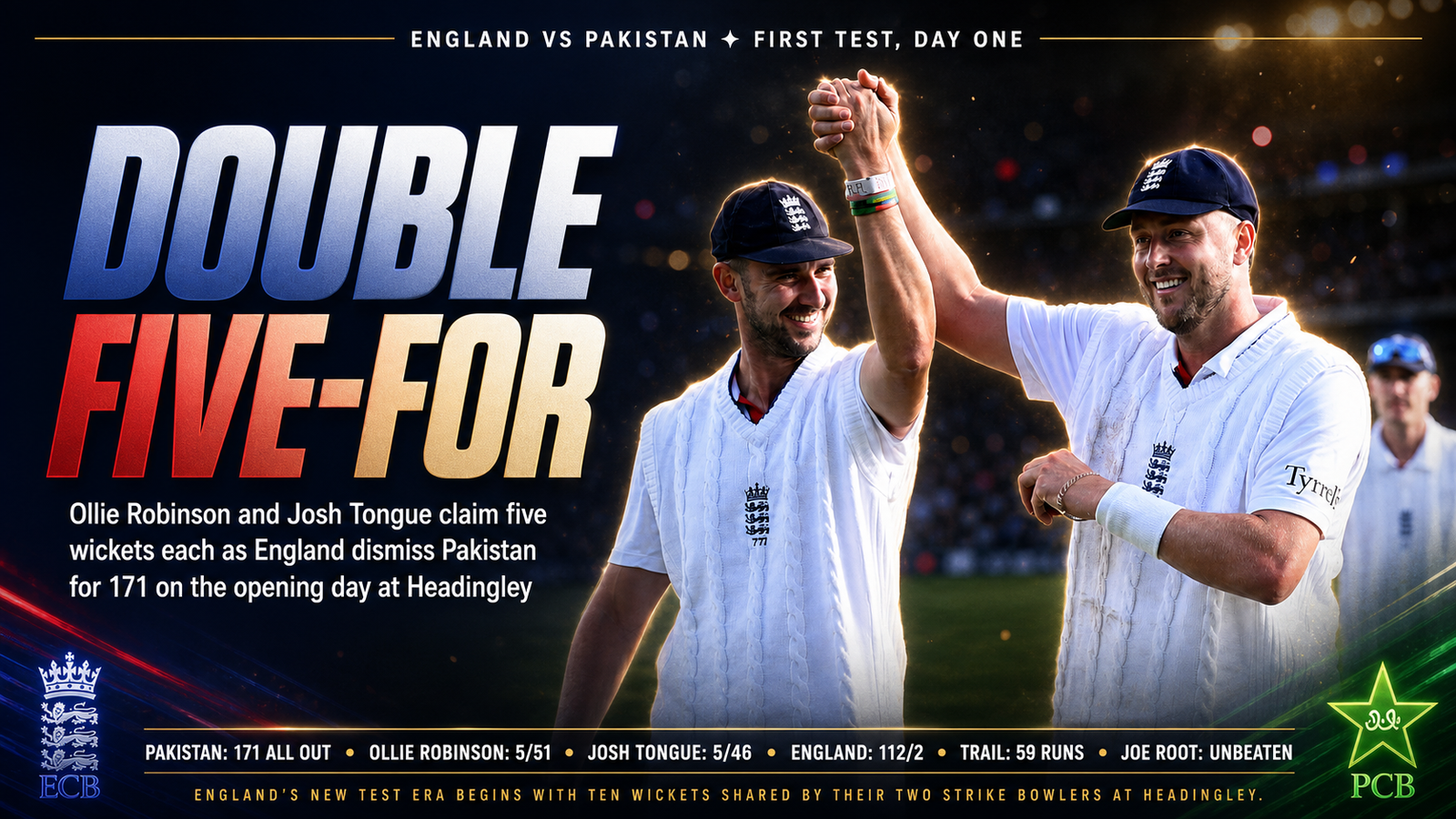
England’s post-Bazball era did not so much begin as detonate. On the opening day of the first Test against Pakistan at Headingley, Ollie Robinson and Josh Tongue took five wickets apiece and Pakistan were bowled out for 171 in barely 48 overs. By stumps, England had reached 112 for two, trailing by just 59 runs, with their new captain Joe Root unbeaten and already hitting six fours.
It was, for a side beginning a fresh chapter under a returning leader, about as emphatic an opening statement as anyone could have scripted.
The context matters here. England have spent the summer shedding the identity that defined them under Ben Stokes and Brendon McCullum, the gung-ho aggression that won them so many admirers and, increasingly, cost them so many matches. Root’s return to the captaincy, three years after he stepped down, was supposed to herald something more measured. What England produced on day one was not exactly cautious. It was just ruthless.
A wicket with the first ball
The tone was set before most of the Headingley crowd had found their seats. Robinson, recalled to the side after a spell in the wilderness, bowled the first delivery of the series and trapped Azan Awais lbw for a golden duck. It was the first time a bowler had taken a wicket with the very first ball of a Test series in England.
Shan Masood, the deposed former captain back in the side, followed in the fifth over, also to Robinson, for five. Pakistan were six for two, and the pattern of the day was set.
Robinson’s return is its own story. The seamer has been in and out of the England setup, his talent never quite matching his output, his fitness a constant subject of scrutiny. But on a Headingley pitch offering him exactly what he wanted, he bowled with the control and craft that made him a Test bowler in the first place, finishing with five for 51 in 18 overs.
Tongue’s burst
If Robinson was the steady hand, Tongue was the sudden eruption. The paceman took five for 46 in just 9.1 overs, a spell of such violence that Pakistan’s resistance simply collapsed in on itself.
The defining sequence came either side of tea. Pakistan, having recovered to 117 for three through an impressive 91 run stand between Imam-ul-Haq and Abdullah Shafique, lost their last seven wickets for 54 runs. Tongue was at the heart of it, bowling stand-in captain Salman Ali Agha for 21 and trapping Ali Usman lbw with the next ball to put himself on a hat-trick.
From a position of relative stability, Pakistan had disintegrated. Imam fell for 42, Shafique, who had top scored with a gritty 61, was clean bowled by a Robinson nip-backer, and the tail offered nothing more than token resistance. Mohammad Rizwan, the experienced wicketkeeper, lasted just long enough to be trapped lbw for 12.
The absence of Babar
It would be unfair to discuss this collapse without acknowledging the elephant in the room. Pakistan are without Babar Azam, their captain and best batter, ruled out of the Headingley Test with a finger injury. Salman Agha is leading in his place, a T20 captain asked to marshal a Test side in the most testing conditions imaginable.
Babar’s absence does not excuse the collapse, but it does explain some of it. This is a batting order that has been built around Babar for a decade, a unit that leans on his calm and his runs when the going gets tough. Without him, the middle order looked exposed, and England’s bowlers sensed it.
Shafique’s 61 and Imam’s 42 were the only innings of note, and even they ended in frustration. The rest of the card reads like a warning: 21, 12, five, zero. A tail that folded under pressure, a middle order that never settled.
For Pakistan, the concern is not just this match but the series. They have not won a Test series in England since 1996, and on this evidence, that drought will not be ending in 2026.
Root’s new era
For all the focus on Pakistan’s failings, this was also England’s day, and Root’s day. The new captain won the toss, elected to field, and watched his bowlers vindicate the decision in spectacular fashion. Then he went out and batted as if the intervening years had never happened, moving to the close unbeaten with six fours already to his name.
Root has led England in 65 Tests, more than any other captain, and he has spoken of returning to the role as a better, more experienced leader than the one who stepped down in 2022. The early signs are encouraging. His bowlers looked purposeful, his field placements smart, and the team carried none of the carelessness that had come to define the Bazball years.
There is a long way to go, of course. One day does not make an era. But for a side that has spent the summer being told it had lost its way, day one at Headingley was a reminder of what England can be when they get it right.
The WTC stakes
The result matters beyond the bragging rights. Both England and Pakistan sit in the lower reaches of the World Test Championship standings, England seventh and Pakistan eighth, and neither can afford to bleed points. England’s strong start puts them firmly in control of a Test they need to win to keep their slim final hopes alive.
For Pakistan, the WTC picture is already bleak, and this collapse does nothing to improve it. They arrived in England needing a strong series to salvage something from their cycle, and they have instead begun it by being dismissed for 171 on the opening day.
The second innings will tell us more, but the signs are not encouraging for a side that has now lost its last seven wickets for a combined 54 runs. That is not a team in control of its fate; that is a team in freefall.
What comes next
England will resume on day two with Root and their remaining batters looking to build a substantial first innings lead. The pitch at Headingley is unlikely to get easier to bat on, and if England can push their total past 300, Pakistan will face an enormous task simply to stay in the contest.
For Pakistan, the immediate priority is survival. They need their remaining batters to show the kind of application that Imam and Shafique managed in patches, and they need their bowlers, Mohammad Abbas chief among them, to find something when their turn comes.
The post-Bazball era has begun with a bang, and Pakistan have been caught in the blast. Whether they can regroup, and whether England can sustain this, are the questions that will define the rest of this match.